
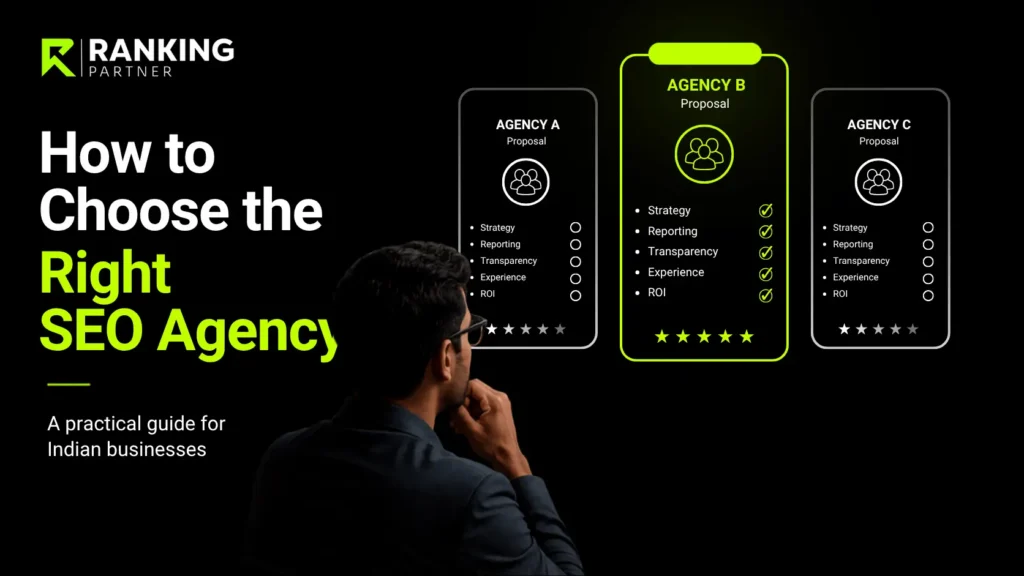
Choosing an SEO agency is a serious business decision. You are not simply paying someone to improve your Google rankings — you are trusting them with your website, content, data, budget, and long-term online visibility.
Before signing an SEO contract, you should understand how the agency works, what it plans to do, how success will be measured, and what you can realistically expect.
The right questions to ask an SEO agency can help you separate a genuine SEO partner from an agency that relies on vague promises.
In this guide, we cover the most important questions to ask, what a good answer should look like, and the red flags you should watch for before making a decision — as part of our SEO services resources for Indian businesses.
- Why Ask Questions Before Hiring an SEO Agency?
- 15 Questions to Ask an SEO Agency
- How to Compare SEO Agencies
- What Should You Ask About SEO Pricing?
- What Makes a Good SEO Agency?
- SEO Agency Red Flags to Never Ignore
- Frequently Asked Questions
- Final Checklist Before Hiring
- Choosing the Right SEO Partner
Why Ask Questions Before Hiring an SEO Agency?
SEO is a long-term process. It can involve technical improvements, keyword research, content, internal linking, authority building, and continuous optimization.
The wrong agency can therefore cost you more than its monthly fee. Poor strategy, low-quality content, risky link-building practices, or months of work without proper implementation can delay your growth.
Before comparing prices, understand how each agency plans to grow your organic visibility. A professional SEO agency should be able to explain its approach in simple language and connect its recommendations to your business goals.
15 Questions to Ask an SEO Agency Before Hiring
1. What Is Your SEO Strategy for My Business?
Start by asking the agency to explain its strategy specifically for your business. A proper strategy should consider your:
- Business model
- Target audience
- Industry
- Competitors
- Website
- Products or services
- Target locations
- Current organic visibility
- Business objectives
An agency should not simply give every client the same SEO package.
Red flag: "We will publish blogs, build backlinks, and improve your rankings." Those are activities, not a strategy.
What a good answer looks like: The agency explains how it will research your market, identify opportunities, prioritize SEO work, and measure progress.
Why it matters: You need to understand why specific SEO work is being recommended, not just what the agency plans to do.
2. What Will You Do During the First 90 Days?
Ask the agency to explain its priorities during the first three months. Depending on your website, this could include:
- Technical SEO audit
- Keyword research
- Competitor analysis
- Search intent analysis
- On-page optimization
- Content planning
- Internal linking
- Local SEO improvements
- Authority-building activities
- Performance tracking
Red flag: "You will reach page one within 30 days." SEO performance depends on many factors, including competition, website authority, content quality, technical condition, and search demand.
What a good answer looks like: The agency explains priorities and dependencies rather than simply promising a certain number of articles or backlinks.
Why it matters: A clear first-90-day plan shows that the agency has considered your website rather than simply applying a standard package.
3. How Do You Choose Which Keywords to Target?
Keyword research should involve much more than finding keywords with high search volume. The right keywords should also match:
- Search intent
- Your services or products
- Target customers
- Competition
- Business value
- Geographic relevance
For example, a keyword with 10,000 searches may generate less business value than a highly relevant keyword with 500 searches.
Red flag: "We always target keywords with the highest search volume."
What a good answer looks like: The agency explains how it balances search demand, competition, relevance, intent, and commercial value.
Why it matters: High traffic is not automatically valuable traffic. You want visitors who are relevant to your business.
4. How Will You Measure SEO Success?
Rankings matter, but they should not be the only measure of success. Ask how the agency will track:
- Organic traffic
- Keyword visibility
- Organic leads
- Conversions
- Important landing pages
- Search Console performance
- Business-specific KPIs
Red flag: "We will send you a ranking report every month." A ranking report alone does not tell you whether SEO is generating business value.
What a good answer looks like: The agency connects SEO performance with meaningful business outcomes.
Why it matters: You should understand what SEO is contributing to your business, not just how many keywords moved up or down.
5. Can You Show Me Relevant SEO Case Studies?
Ask for case studies that are relevant to your situation. Look for businesses with similarities in:
- Industry
- Business model
- Location
- Website size
- Competition
- SEO objectives
You do not necessarily need to see the agency's biggest client. You need to see evidence that its approach can work in situations similar to yours.
Red flag: The agency makes broad claims about success but cannot provide meaningful examples or explain what it actually did.
What a good answer looks like: The agency can explain the starting situation, strategy, work performed, timeframe, and measurable outcome.
Why it matters: Relevant evidence is more useful than simply hearing that an agency has "many years of experience."
6. Who Will Actually Work on My SEO Campaign?
Ask who will be responsible for your campaign after the sales process is over. You can ask:
- Who manages the strategy?
- Who handles content?
- Who handles technical SEO?
- Who handles link building?
- Who communicates with me?
- Is any work outsourced?
Red flag: You speak with a senior strategist during the sales process and later discover that your account is handled by a completely different team without clear communication.
What a good answer looks like: The agency clearly explains its team structure and responsibilities.
Why it matters: You should know who is responsible for the work you are paying for.
7. Do You Implement Technical SEO Changes or Only Provide Recommendations?
This is one of the most important questions many businesses forget. An agency may provide a detailed technical SEO audit containing dozens of recommendations. But who actually implements those changes?
Red flag: "We will give you the audit. Your developer needs to implement everything." That arrangement can work, but you need to know about it before signing the contract.
What a good answer looks like: The agency clearly explains whether it implements changes directly, works with your developer, provides implementation instructions, or reviews completed changes.
Why it matters: A technically strong recommendation has little value if important changes never get implemented.
8. What Is Your Approach to SEO Content?
Ask how the agency decides what content your website needs. A strong content process should consider:
- Search intent
- Keyword opportunities
- Audience needs
- Existing content
- Competitor coverage
- Topic depth
- Internal linking
- Business relevance
Red flag: "We publish 20 articles every month." A higher publishing volume does not automatically mean better SEO.
What a good answer looks like: The agency talks about creating useful content that satisfies search intent and supports your business goals.
Why it matters: Publishing content without a clear strategy can create large amounts of content without meaningful organic visibility.
9. How Do You Build Backlinks?
Ask the agency how it approaches link acquisition. Important questions include:
- What types of websites do you target?
- How do you evaluate link opportunities?
- How do you determine relevance?
- Do you use outreach?
- Do you buy links?
- Do you use automated networks?
Red flag: "We guarantee 500 backlinks every month." A fixed number of backlinks should not be treated as the main measure of SEO quality.
What a good answer looks like: The agency can explain its approach to quality, relevance, context, and risk.
Why it matters: You want authority-building work that supports your website rather than exposing it to unnecessary risk.
10. How Long Should I Expect SEO to Take?
Be cautious if an agency promises a specific ranking position or dramatic results within a few weeks. SEO timelines can vary based on website history, competition, existing authority, technical condition, content quality, industry, location, search demand, and scope of work.
As a broad planning expectation, businesses may need several months before meaningful SEO results become clear. A 3–6 month timeframe can be useful for planning, but it should never be presented as a guarantee.
Red flag: "We guarantee page-one rankings within 30 days."
What a good answer looks like: The agency explains what progress you should expect to evaluate over time and acknowledges that results vary.
Why it matters: No agency completely controls Google's search results.
11. What Will You Report Every Month?
Ask the agency to show you a sample SEO report before signing. A useful report should help you understand:
- What was completed
- What changed
- What performed well
- What did not perform well
- Organic traffic trends
- Keyword visibility
- Important conversions where measurable
- Problems identified
- What happens next
Red flag: A report contains dozens of charts but never explains what the agency actually did or what should happen next.
What a good answer looks like: The agency combines performance data with explanations and next steps.
Why it matters: Reporting should help you make decisions, not simply prove that the agency produced a report.
12. What Happens If Rankings or Traffic Decline?
SEO does not move in a straight line. Performance can change because of Google algorithm updates, competitor activity, website changes, technical issues, content changes, or changes in search behaviour.
Red flag: "Ranking fluctuations are normal. Don't worry about them." Some fluctuations are normal, but repeatedly ignoring performance changes is not a strategy.
What a good answer looks like: The agency investigates the cause, identifies affected areas, and adjusts the strategy based on evidence.
Why it matters: You want an agency that can diagnose problems and respond, rather than simply report them.
13. What Happens If I Cancel the Contract?
Read the contract carefully before signing. Ask about:
- Notice periods
- Outstanding payments
- Website access
- Content ownership
- SEO data
- Reports
- Campaign assets
- Transition support
Red flag: The agency is unwilling to explain what happens to your website, data, content, or accounts after cancellation.
What a good answer looks like: The agency clearly explains the exit process and what happens to your assets after the relationship ends.
Why it matters: Your business should not become dependent on an agency simply because you cannot access your own digital assets.
14. Will I Retain Ownership of My SEO Data and Digital Assets?
This deserves special attention. Make sure you understand who controls access to important assets such as:
- Google Search Console
- Google Analytics
- Google Business Profile
- Website/CMS
- Domain
- Content
- SEO reports
- Other business accounts
Where possible, your business should retain appropriate ownership and administrative access.
Red flag: "We created the account, so everything stays with us."
What a good answer looks like: The agency works through your existing business accounts or provides appropriate access and clearly explains ownership.
Why it matters: An SEO agency is a service provider. Your core digital business assets should remain accessible to your business.
15. What Exactly Is Included in Your Monthly SEO Fee?
Never compare SEO agencies based only on monthly price. Ask each agency to explain exactly what is included.
| Area | Questions to Ask |
|---|---|
| Strategy | Is strategy included? |
| Technical SEO | Who implements recommendations? |
| Content | What content work is included? |
| Internal linking | Is optimization included? |
| Link building | What type of work is included? |
| Reporting | What will I receive each month? |
| Communication | How often will we discuss progress? |
| Tools | Are important SEO tools included? |
Red flag: A very low monthly fee comes with an extremely broad promise covering everything.
What a good answer looks like: The agency provides a clear scope of work and explains what is included and what costs extra.
Why it matters: The cheapest proposal is not necessarily the best value.
How to Compare SEO Agencies Before Hiring One
If three agencies are pitching you at the same time, do not automatically choose the cheapest proposal or the one promising the largest number of deliverables.
Agency A — promises the most backlinks
Agency B — promises the most content
Agency C — promises the lowest price
Use a simple comparison framework instead:
| Evaluation Area | Agency A | Agency B | Agency C |
|---|---|---|---|
| SEO strategy | |||
| Relevant experience | |||
| Keyword research | |||
| Technical SEO | |||
| Content strategy | |||
| Link-building approach | |||
| Implementation | |||
| Reporting | |||
| Communication | |||
| Contract terms | |||
| Ownership/access | |||
| Monthly investment |
The goal is not to find the agency offering the most work. The goal is to find the agency offering the right work for your business. Look at the quality, relevance, process, implementation, transparency, and business value — not just the numbers.
What Should You Ask About SEO Pricing?
SEO pricing in India can vary significantly depending on the website, competition, industry, target market, and scope of work.
Instead of asking only "How much does SEO cost?", ask: "What exactly will you do for this monthly investment?"
Compare strategy, keyword research, technical SEO, content, on-page optimization, internal linking, link acquisition, reporting, implementation, and communication.
A higher-priced SEO package is not automatically better. Likewise, an unusually cheap package may not provide enough resources to perform meaningful SEO work. The important question is whether the scope of work matches your business objective.
If you're comparing packages by cost, our SEO services guide breaks down typical pricing tiers in more detail.
What Makes a Good SEO Agency?
A good SEO agency should be able to explain its work clearly. Look for an agency that:
Understands Your Business
Researches your market before recommending a strategy, rather than applying a generic package.
Sets Realistic Expectations
Explains timelines honestly instead of promising guaranteed rankings within weeks.
Uses Relevant Keyword Research
Balances search demand, intent, competition, and commercial value.
Connects SEO with Business Goals
Ties rankings and traffic back to leads, conversions, and revenue.
Has a Clear Technical Process
Explains how technical SEO recommendations actually get implemented.
Communicates and Reports Clearly
Gives you useful reporting and appropriate access to your own digital assets.
Most importantly, the agency should be able to explain why it is recommending something.
SEO Agency Red Flags You Should Never Ignore
Be particularly careful if an agency:
- Guarantees a specific Google ranking
- Promises dramatic results in a few weeks
- Talks only about the number of backlinks
- Uses the same strategy for every business
- Cannot explain its keyword-selection process
- Refuses to explain who does the actual work
- Provides reports without explaining them
- Controls important business accounts without appropriate client access
- Avoids explaining contract terms
- Focuses entirely on rankings instead of business outcomes
One red flag does not automatically mean an agency is bad. But several together should make you slow down and ask more questions.
Frequently Asked Questions
Ask about its strategy, keyword research, first 90 days, technical SEO implementation, content, backlinks, reporting, timelines, pricing, contract terms, and digital asset ownership. The most important question is not simply "what will you do?" It is "why are you recommending this work for my business?"
Look for transparency, relevant experience, realistic expectations, clear deliverables, useful reporting, and a willingness to explain its methods. Be cautious with agencies that rely heavily on guarantees or vague promises.
Be cautious of any agency that guarantees a specific Google ranking. Search results depend on many factors outside an agency's complete control. A professional agency should focus on executing a sound SEO strategy, measuring progress, and adapting based on evidence.
The timeline varies depending on competition, website condition, authority, content, industry, and the amount of work being performed. SEO generally requires several months of consistent work. Be cautious about agencies promising dramatic results within a few weeks.
A useful report should cover important performance changes, work completed, keyword visibility, organic traffic, relevant conversions where measurable, problems identified, and next steps.
Not necessarily. Compare agencies based on strategy, scope, expertise, implementation, reporting, transparency, and expected business value rather than monthly price alone.
Final Checklist Before Hiring an SEO Agency
Before signing an SEO contract, make sure you can answer yes to these questions:
- Do I understand the agency's strategy?
- Do they understand my business?
- Have they explained what happens during the first 90 days?
- Do I understand how they choose keywords?
- Do they have relevant experience?
- Do I know who will work on my account?
- Do I know who implements technical changes?
- Do I understand their content strategy?
- Do I understand their link-building approach?
- Do they have realistic expectations about timelines?
- Do I understand their reporting?
- Do I retain appropriate access to my digital assets?
- Do I understand the contract and cancellation terms?
- Do I know exactly what my monthly fee includes?
If several answers are unclear, do not rush into signing the contract.
Choosing the Right SEO Partner
Choosing an SEO agency is ultimately about more than rankings. You need a partner that understands your business, explains its strategy clearly, communicates honestly, and can show you what your investment is actually paying for.
The right questions help you look beyond polished sales presentations and compare agencies based on their strategy, execution, transparency, and accountability.
At Ranking Partner, SEO is at the core of what we do. We focus on building SEO strategies around the individual business rather than applying the same package to every client.
If you want to discuss your current SEO situation or understand what your website actually needs, talk to Ranking Partner.
Ready to find an SEO partner you can trust?
Talk to Ranking Partner →